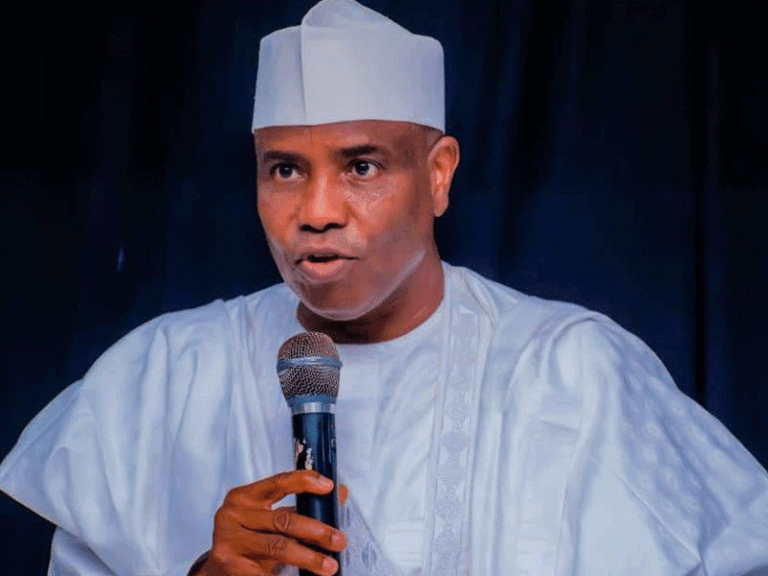






The Chairman of the National Health Insurance Authority (NHIA), Senator (Dr) Ibrahim Oloriegbe, has called for the urgent establishment of a dedicated mental health department in Nigeria to implement the provisions of the Mental Health Act.
Oloriegbe made the call during a special interactive session at the 2025 Mental Health Leadership and Advocacy Programme (mhLAP), held under the theme “Building Advocacy for Mental Health”, with participants drawn from across Africa.
He expressed concern over the rising cases of drug abuse, suicides, and untreated mental health disorders, particularly among adolescents and young people. To address these challenges, he urged that the federal government provide a properly structured Mental Health Fund backed by clear operational guidelines.
“The Minister of Health should, as a matter of urgency, establish a mental health department. That is the only way to operationalise the bill,” Oloriegbe said.
“For the 2026 budget, the National Assembly should allocate at least ₦4 billion to the Mental Health Fund created by the Act. Without adequate funding, the department will not be able to carry out its mandate.”
Also speaking, Dr Abdulaziz Mohammed, Head of the Division of Disease Prevention and Control at the Africa CDC, stressed that most social determinants of mental health—including education, communication, lifestyle, and nutrition—lie outside the health sector. He explained that this was why the Africa CDC was championing multisectoral action in the prevention and control of non-communicable diseases and mental health.
He noted that 95 percent of Africans who need treatment for mental health conditions do not receive it, describing mental health as the most neglected of all non-communicable diseases. He added that some countries on the continent still rely on outdated mental health laws.
“This short course is one of five interventions the Africa CDC is implementing to improve mental health on the continent,” Mohammed said.
Former mhLAP course director, Emeritus Professor Oye Gureje, commended the Africa CDC for supporting the two-week training programme, which has attracted participants from 27 African countries since inception. He said the initiative seeks to spread mental health advocacy beyond healthcare providers.
“We need a large number of advocates, not just within the health system, but across the media, NGOs, civil society, and women’s groups, so they can champion the development of mental health services,” Gureje said.
He warned that without full implementation of the Nigeria Mental Health Act of 2023, millions of Nigerians with mental health conditions would continue to be denied access to effective treatment.