





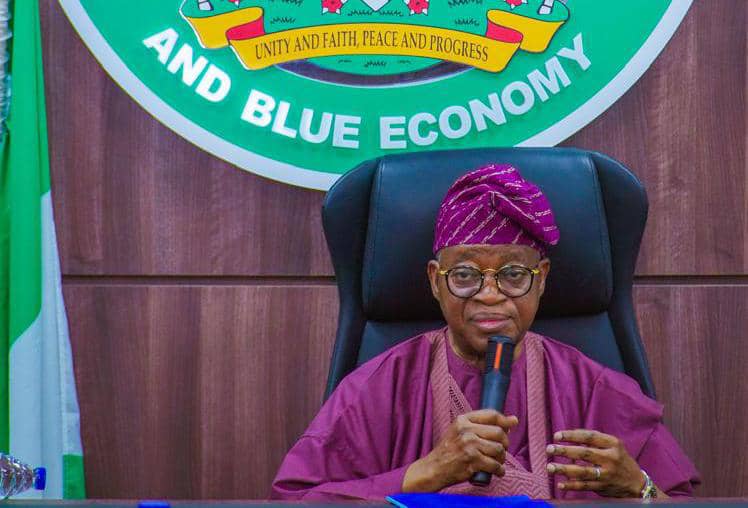
The Minister of Marine and Blue Economy, Adegboyega Oyetola, has called for an urgent review and abolition of the war risk insurance premiums imposed on vessels sailing to Nigeria, describing them as outdated and detrimental to the country’s economic competitiveness.
Oyetola made the appeal in Lagos at the 3rd Annual Maritime Lecture organized by the Maritime Reporters Association of Nigeria (MARAN). He was represented by his Special Adviser on Media and Communications, Dr. Bolaji Akinola.
The minister highlighted key achievements in Nigeria’s maritime industry since the establishment of the Ministry of Marine and Blue Economy in 2023, while pressing for Nigeria’s removal from global high-risk maritime classifications.
Among the reforms he listed were:
- The resolution of the long-standing Apapa gridlock, which had stifled port efficiency and discouraged investment.
- The launch of Africa’s first National Policy on Marine and Blue Economy, providing a framework for shipping, fisheries, offshore energy, aquaculture, tourism, and related services.
- Federal approval for the modernization of Lagos and Tin Can Island ports, with plans for upgrades at Eastern ports nearing completion.
- Record revenue growth, with agency earnings rising from ₦700.79 billion in 2023 to ₦1.39 trillion in 2024 — the highest in Nigeria’s maritime history.
- The activation of the long-delayed Cabotage Vessel Financing Fund to support indigenous shipowners.
- Establishment of a National Flag Carrier Technical Committee to develop a private-sector-led national shipping line.
- Progress in food security through increased local fish production, aquaculture support for riverine communities, and enhanced inland waterways safety via new regulations, improved patrols, and stricter vessel standards.
Despite these milestones, Oyetola expressed concern over the continued imposition of war risk insurance premiums, which he said had cost Nigeria an estimated $1.5 billion in recent years. He argued that the charges no longer reflect present realities, given the country’s improved maritime security.
He credited the success of the Deep Blue Project—implemented by the Nigerian Maritime Administration and Safety Agency (NIMASA) in partnership with the Nigerian Navy—for achieving zero piracy incidents in Nigerian waters over the past four years. This, he noted, has already earned Nigeria recognition from the International Maritime Organization, the International Maritime Bureau, and removal from the International Bargaining Forum’s high-risk list.
Oyetola, however, criticized insurers, particularly Lloyd’s of London, for failing to update their classifications, thereby imposing unnecessary costs on Nigerian businesses and consumers. He disclosed that Nigeria is engaging with global stakeholders such as BIMCO, the International Chamber of Shipping, and Lloyd’s, armed with data that proves significant security improvements.
The minister added that the government is also strengthening maritime security through regular reporting, deeper regional cooperation under the Yaoundé Architecture, and the promotion of local maritime insurance to retain value within the economy.
Declaring the lecture open, Oyetola expressed optimism about the future of Nigeria’s blue economy, emphasizing that the progress made in the past two years illustrates what is possible through vision and collaboration.
He called on industry stakeholders to contribute ideas that will shape government policy and drive further growth in the maritime sector. “The future is bright,” he concluded, reaffirming the administration’s commitment to modernizing ports, supporting local operators, expanding fisheries, and positioning the blue economy as a foundation for sustainable growth, jobs, and prosperity.