



A devastating fire at the Great Nigeria Insurance (GNI) building on Lagos Island has left at least eight people dead, destroyed goods worth billions of naira and wiped out the livelihoods of hundreds of traders who had stocked up for the Christmas season with borrowed funds.
The Christmas Eve inferno, which tore through one of the busiest commercial hubs in Lagos, has not only plunged families into grief and traders into financial ruin, but also exposed deep-seated failures in emergency response, market safety enforcement and financial protection for Nigeria’s vast informal economy.
For Aina Babatunde, a Balogun Market trader of over a decade, the fire consumed the biggest investment of her life. Only days before the incident, she had returned from China with large consignments of bags, shoes and clothing valued at nearly ₦25 million, purchased largely on credit to meet festive demand. The goods were stored in her rented warehouse spaces inside the GNI building, where she had kept stock for six years.
“I was planning to expand. This was the largest batch of goods I had ever bought,” Babatunde, a widow with three children, told BusinessDay Investigations. “I took a loan from my cooperative, believing Christmas sales would help me grow the business.”
On the afternoon of the fire, Babatunde had visited the warehouse to inspect the new stock and distribute items to her four stalls in Balogun Market. By the time smoke rose from nearby Breadfruit Street, she had no idea the fire was already tearing through the building that held her future.
“Millions were on fire, and I couldn’t do anything about it,” she said, her voice breaking. “How do I repay the loan? How do I start again?”
Lives lost amid desperate rescue attempts
Inside the GNI warehouse, three friends and business partners — Mrs Dorcas Adejobi, Mrs Olaide Afolabi and Mrs Temitope Ezekiel — had spent years building a joint trading enterprise. Since 2018, they pooled resources and shared profits, with each specialising in different product lines.
On that Christmas Eve, they were inspecting newly arrived stock and discussing plans for Ezekiel’s daughter’s wedding when smoke began billowing from the upper floors around 4:15 pm.
As panic spread, the women and other traders scrambled to salvage what they could. Boxes were dragged toward stairwells and thrown to the ground floor as flames closed in. They managed to clear two of their three stores. Then Ezekiel made a fatal decision to return for the last batch of goods.
She never came back.
Her charred body was recovered days later, identified only by a silk scarf her friends had once bought for her. Around her lay piles of burnt merchandise — evidence of a final, desperate attempt to save not just goods, but years of hope built on borrowed capital.
Delayed response, compounding losses
Eyewitnesses described scenes of chaos as traders and residents tried to battle the fire with buckets of water before emergency responders arrived. Local youths, often referred to as “area boys,” were among the first to respond, but their efforts were quickly overwhelmed.
Several witnesses said calls were placed to the Lagos State Fire and Rescue Service shortly after smoke became visible, but fire engines did not arrive until nearly two hours later. Even then, responders reportedly struggled with inadequate equipment, including hoses too short to reach the upper floors.
As the blaze spread, neighbouring buildings — including a mosque, a seven-storey commercial complex and several smaller structures — were engulfed.
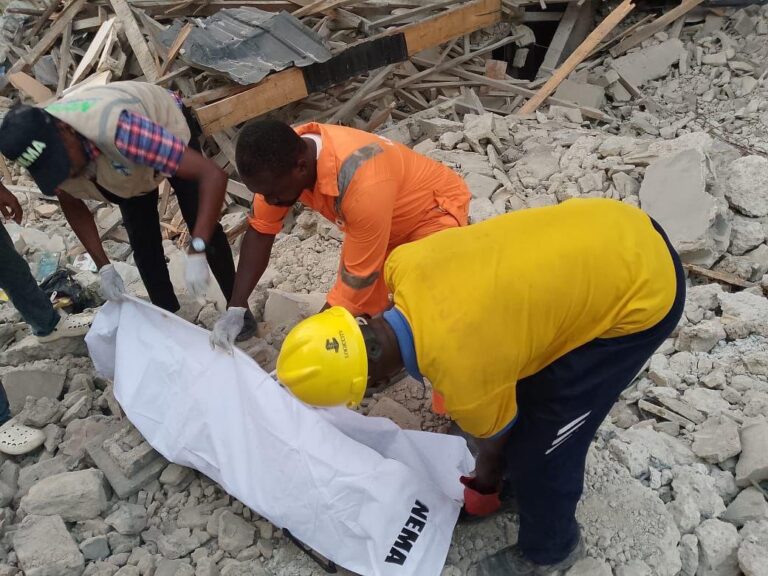
By the time emergency agencies, including LASEMA, NEMA and the fire service, gained partial control, at least eight people were confirmed dead, while 13 others were rescued alive. Some bodies were so badly burned that DNA testing may be required for identification.
Governor Babajide Sanwo-Olu, who later visited the site, described the tragedy as a reflection of long-standing safety and structural failures within the Balogun Market axis. He ordered a comprehensive safety audit, citing unapproved constructions, generators placed on upper floors and shops dangerously close to electrical transformers.
Billions in losses, no safety net
Market leaders estimate that traders lost more than ₦5 billion in goods, a figure expected to rise as more inventories are assessed. The GNI building housed over 100 warehouse units, many filled with newly imported goods from China and Turkey for the festive season.
Alhaja Mistura Bamidele, the Balogun Market leader, said many traders had recently received container shipments.
“Almost all the warehouses were fully packed,” she said. “One cargo company alone confirmed that over 30 containers were destroyed.”
A logistics firm, Wait and Carry, confirmed in a notice that all containers stored at the GNI warehouse were lost and declared the incident a force majeure event, ruling out refunds.
Asked whether traders had insurance coverage, Bamidele shook her head. “We are local women. We don’t know insurance. We just pray that this kind of thing doesn’t happen.”
Search for closure continues
More than 10 days after the fire, smoke still hung thick in the air as excavators pulled down the damaged building floor by floor. Rescue teams continued to retrieve bodies from the debris.
For Kemi Lawal, whose younger brother Michael, 38, remains missing, closure matters more than rebuilding her business.
“I just want to see him again,” she said. “Even if he is dead, I want to bury him properly.”
Rescue officials believe more bodies may still be trapped beneath the rubble. According to Gbolahan Ige, head of rescue operations at the Lagos Neighbourhood Safety Agency, about 75 percent of the building was initially inaccessible due to the tightly packed nature of surrounding structures.
“We strongly believe more people are still trapped inside,” Ige said, adding that at least 13 people have been officially reported missing so far.
A familiar tragedy
The GNI fire is the latest in a long history of market infernos in Lagos Island, with major incidents recorded in 2019, 2020 and 2022. Experts warn that without a shift from reactive responses to proactive fire prevention, similar disasters are inevitable.
Beyond the ashes, the tragedy has laid bare the fragility of Nigeria’s informal economy — where traders rely on loans, store goods in unsafe buildings and operate without insurance — leaving millions one fire away from total ruin.