



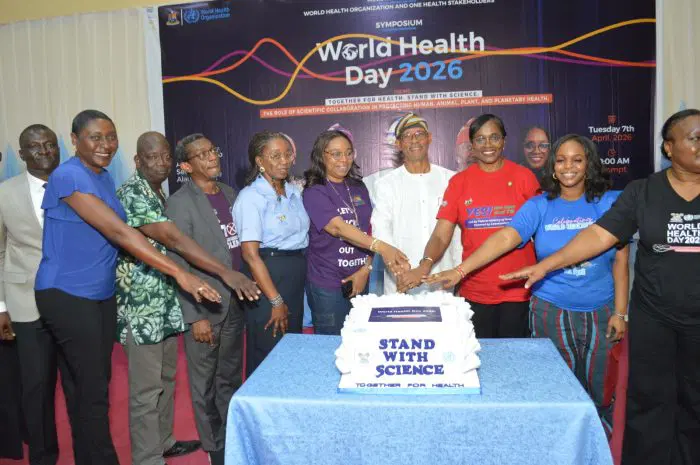
As the world marked World Health Day 2026, Lagos State stepped forward with a bold message: Nigeria’s struggling healthcare system can still be saved, but only through science, data, and sweeping reforms.
At a high-stakes symposium held in Ikeja, policymakers, scientists, and global health partners confronted a critical question can evidence-based strategies fix a system long plagued by weak execution and fragmented policies? Their answer was clear: yes, but time is running out.
Leading the charge, Lagos State Commissioner for Health, Akin Abayomi, declared a decisive shift away from guesswork toward a system powered by research, surveillance, and real-time data.
According to him, Lagos is building a healthcare model that is not just reactive, but predictive and resilient—one capable of anticipating and neutralizing future health threats.
A striking example of this transformation lies in malaria treatment. Abayomi revealed that what was once assumed to be widespread malaria cases has been drastically corrected through science. Malaria positivity rates in public facilities have plunged from 60 percent to just five percent, exposing years of misdiagnosis and unnecessary treatment.
The revelation underscores a deeper crisis: Nigeria has long been treating assumptions rather than confirmed illnesses wasting resources and putting lives at risk.
Beyond diagnostics, Lagos is ramping up digital health systems, strengthening data infrastructure, and investing heavily in research. Nearly 15 percent of the state’s budget is now allocated to health, alongside major infrastructure projects designed to reduce medical tourism and boost local capacity.
Among these are the ambitious Massey Children’s Hospital, a new General Hospital in Ojo, and a massive 1,000-bed mental health institute projects that signal a long-term commitment to healthcare transformation.
But infrastructure alone won’t fix the system.
Health leaders stressed that Nigeria’s problems are deeply interconnected. Kemi Ogunyemi, Special Adviser to the Governor on Health, warned that diseases like malaria, HIV, and malnutrition cannot be tackled in isolation. She called for mandatory health insurance, stronger emergency systems, and deeper investment in digital health.
The push for compulsory insurance, she noted, is critical to achieving universal health coverage and reducing the heavy financial burden on millions of Nigerians.
The call for collaboration echoed across sectors. Officials highlighted the “One Health” approach—linking human, animal, and environmental health—as essential for tackling modern health threats.
Environmental expert Omobolaji Gaji warned that pollution and poor waste management continue to fuel disease, stressing that siloed approaches are no longer sustainable.
From the global stage, Chinyere Okafor of the World Health Organization urged Nigeria to invest more in homegrown research while strengthening international collaboration.
Meanwhile, Njide Ndili pointed to a critical blind spot—the failure to integrate private sector data, which continues to weaken national health planning.
On the frontlines of disease control, Lagos is also strengthening surveillance systems using digital tools like SORMAS, while investing in climate-resilient infrastructure to prepare for future outbreaks. Officials cited the successful containment of an anthrax outbreak as proof that coordinated action works.
Despite these gains, experts issued a sobering warning: without sustained investment, stronger data integration, and a relentless fight against misinformation, progress could stall.
The message from Lagos was unmistakable—Nigeria stands at a crossroads. Embrace science, collaboration, and reform, or risk a healthcare system pushed beyond its limits.