




Nigeria could be losing significant tax revenue and facing challenges in managing public wealth because of an estimated N30 trillion gap in the valuation and documentation of properties and other assets, the Estate Surveyors and Valuers Registration Board of Nigeria (ESVARBON) has warned.
The Board said inadequate and unreliable valuation of assets was affecting property taxation, public-sector accounting, insurance, estate management and the government’s ability to establish the true value of assets under its control.
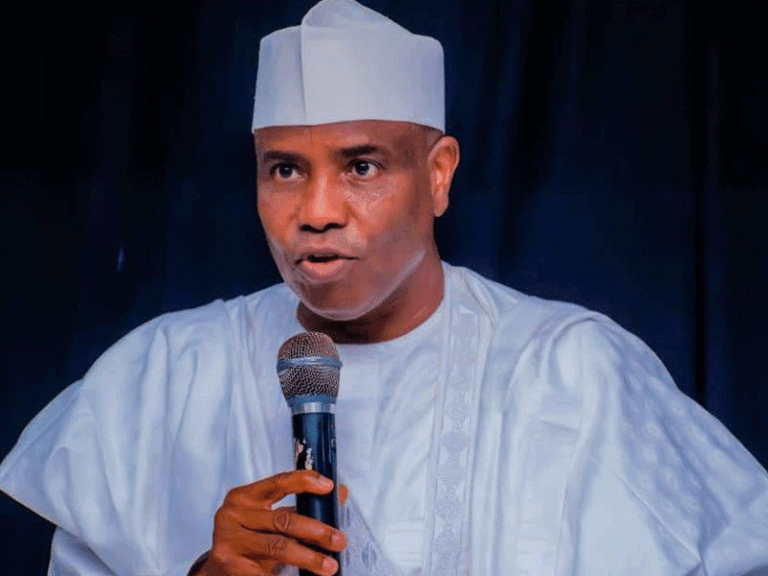
Acting Chairman of ESVARBON, Dr Aminu Waziri, raised the concern at the 2026 Valuers Assembly in Abuja, where he called for government institutions to adopt systematic processes for identifying, valuing and documenting public assets in line with internationally recognised standards.
Waziri specifically urged Ministries, Departments and Agencies to implement the International Public Sector Accounting Standards, saying the framework would support the development of a reliable inventory of government assets and provide a clearer basis for determining their value.
He said consistent professional valuation would improve government’s understanding of the assets in its possession and strengthen accountability, planning and policy decisions.
According to him, the valuation challenge also has wider implications for the housing sector, which he said was dealing with a deficit of more than 21 million housing units.
A former chairman of the ESVARBON Education Committee and board member of the International Valuation Standards Council, Dr ESV Uche Egwuatu, said greater use of professional valuers could also help government generate more revenue from the property sector.
Egwuatu said registered estate surveyors and valuers had the technical expertise required to establish both market and taxable property values but were not being sufficiently engaged by government.
She noted that reliable property valuation was particularly important as the Federal Government seeks to broaden the tax base and improve Nigeria’s tax-to-GDP ratio.
According to her, taxes and charges including property tax, capital gains tax, capital transfer tax and estate duties depend heavily on credible information about the value of assets.
Egwuatu warned that when government agencies lacked accurate property valuations, tax assessments could become inconsistent and create opportunities for revenue losses.
She therefore called for registered valuers to play a larger role in government asset valuation, property portfolio management, taxation and the formulation of policies affecting the real estate market.
The experts also linked the valuation gap to potential challenges in the insurance sector.
Waziri explained that inaccurate valuation before insurance coverage could result in property owners receiving inadequate compensation when insured assets were damaged or destroyed.
He said professional valuation would help insurers determine appropriate levels of indemnity and provide a stronger basis for claims settlement.
Beyond physical assets, the assembly also considered the growing complexity of valuing intangible assets such as intellectual property and other assets without a physical form.
During a presentation, Edwina Tam of Kroll examined the application of International Valuation Standards 210 to intangible assets and highlighted the difficulties involved in determining their worth, particularly where comparable market data is limited.
The presentation reviewed the market, income and asset approaches commonly used in valuation, alongside methodologies such as relief-from-royalty, multi-period excess earnings and with-and-without approaches.
Participants also examined the impact of technology and artificial intelligence on the valuation profession.
The discussions highlighted the increasing importance of data analytics, specialised industry knowledge, adherence to global valuation standards, continuous professional development and professional scepticism as technology becomes more integrated into valuation processes.
The assembly concluded that stronger valuation systems could support Nigeria’s efforts to improve tax administration, enhance public-sector financial reporting, strengthen insurance protection, improve property-market regulation and establish more reliable information on the nation’s assets.