



Nigeria’s healthcare system is showing clear signs of revival as the Federal Government announced major gains in maternal and newborn survival, vaccination coverage, and health service utilisation—while outlining ambitious fiscal and reform targets to sustain the momentum.
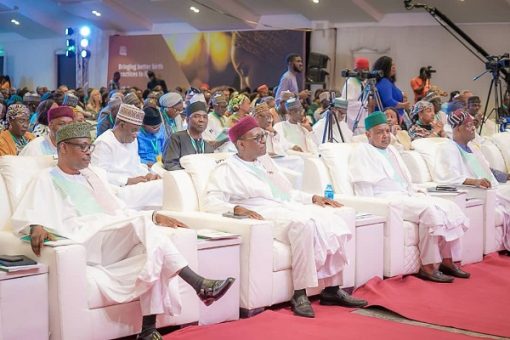
At the 2025 Joint Annual Health Sector Review (JAR) in Abuja, the Coordinating Minister of Health and Social Welfare, Prof. Ali Pate, revealed that the government plans to mobilise ₦150 billion for vaccine procurement in 2025 and 2026 to strengthen routine immunisation and epidemic preparedness.
The government is also introducing health-focused taxes on sugar-sweetened beverages, expanding public-private health partnerships, and deploying digital tools to improve transparency and accountability.
As part of a sweeping national planning effort, Pate said all 8,809 wards across Nigeria are undergoing World Bank-supported mapping to align local health plans with state and national priorities. He added that work is underway on Nigeria’s next long-term blueprint—the 2026–2050 National Development Plan.
84% of health reform targets on track
Pate disclosed that 84 percent of key indicators under the Nigerian Health Sector Renewal Investment Initiative (NHSRII) are progressing as expected, with 35 states conducting annual reviews and citizens actively tracking outcomes.
He highlighted measurable improvements:
- 17% decline in maternal deaths
- 12% drop in newborn deaths across 172 high-burden LGAs
- 15,000+ new health workers recruited
- 435 primary healthcare centres revitalised
- 33% increase in access to skilled birth attendants
- Visits to PHCs funded by BHCPF surged from 10 million in early 2024 to 45 million by mid-2025
Routine immunisation for measles, yellow fever, and HPV also improved, while family planning uptake rose by 10 percent.
Public confidence in government-led health reforms, he said, has risen to 55 percent, with patient satisfaction now at 74 percent.
Funding and workforce reforms gain momentum
Despite progress, Pate acknowledged persistent gaps in affordability and health insurance coverage—currently around 12 percent—but said efforts are underway to expand enrollment and strengthen accountability.
He noted that 20,000 frontline workers were hired in federal tertiary hospitals within the last year, while President Bola Ahmed Tinubu approved over ₦50 billion to clear long-standing workforce allowances.
Edun: Health budget jumps nearly 60%
Coordinating Minister of the Economy and Finance, Wale Edun, said the Federal Government’s renewed fiscal strategy is already reflecting in the health budget, which jumped by nearly 60 percent for 2025.
The Basic Health Care Provision Fund (BHCPF) is also set to rise from ₦131.5bn in 2024 to almost ₦299bn by 2026, raising health’s share of the budget from just over 3 percent to 5.2 percent.
“The turnaround in the economy has begun,” Edun said. “Social sectors like health are now benefiting significantly.”
He urged state and local governments to channel their improved revenues into health and education.
Bagudu: Nigeria’s low revenue-to-GDP must change
Minister of Budget and Economic Planning, Sen. Atiku Bagudu, said Nigeria’s revenue-to-GDP ratio—below 8 percent since 2007—remains one of the country’s biggest obstacles to growth.
He said the new long-term development plan aims to position Nigeria among the world’s major economies within five years.
Ward-level mapping, he explained, will ensure community health priorities feed directly into state and federal development strategies.
Salako: Renewed Hope Agenda reshaping health sector
Minister of State for Health and Social Welfare, Dr. Adekunle Salako, said the Renewed Hope Agenda has triggered infrastructure renovations, workforce expansion, and system-wide reforms.
He listed over 500 high-impact projects, 13 tertiary institutions, six cancer centres of excellence, and 21 strategic policies now driving improvements across the sector.
Digital health initiatives, he added, are linking thousands of facilities, while primary healthcare revitalisation efforts could save Nigeria ₦4.8 trillion annually from preventable diseases and retain ₦850 billion lost to medical tourism.
He urged states to increase BHCPF counterpart funding, scale insurance coverage, and strengthen PHCs, while calling on private investors and development partners to align resources with national priorities.
A national compact expanded
The highlight of the three-day review was the expansion of the Health Sector Renewal Compact, now formally endorsed by local governments, traditional rulers, private sector leaders, and civil society groups—strengthening the unified front first formed in 2023 by the Federal Government, states, and global partners.