




Nigeria’s recent progress in slowing inflation may come under pressure as global geopolitical tensions and persistent structural challenges threaten to reverse the downward trend.
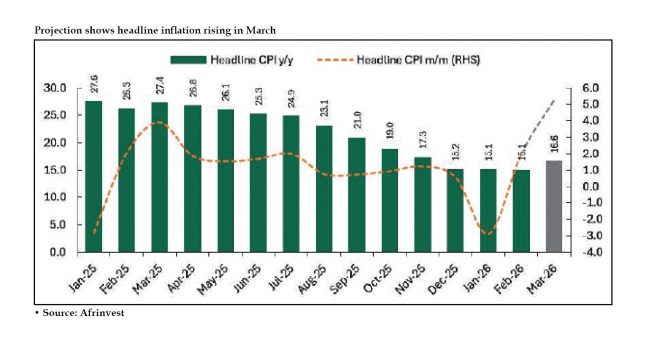
Data from the National Bureau of Statistics showed that headline inflation eased slightly to 15.06 per cent in February 2026, marking the 12th consecutive month of disinflation. However, analysts warn that this trend could soon be disrupted.
Economic experts point to the ongoing tensions involving the United States, Israel, and Iran as a key external risk, with rising crude oil prices already triggering higher energy and transportation costs domestically.
The National Insurance Commission cautioned that escalating instability in the Middle East could translate into increased insurance premiums for Nigerian businesses, further compounding cost pressures.
Meanwhile, the Central Bank of Nigeria reiterated its commitment to reducing inflation to a single-digit range of between six and nine per cent over the medium term, as it transitions toward a full inflation-targeting monetary policy framework.
Analysts at Afrinvest West Africa highlighted growing downside risks, noting that crude oil prices have surged to about $105 per barrel from $72.69 at the end of February. This has driven a sharp increase in domestic fuel prices, with petrol, diesel, and cooking gas recording significant hikes across the country.
The resulting rise in transportation, logistics, healthcare, and food costs—combined with longstanding structural issues such as inadequate power supply, poor road infrastructure, and insecurity—is expected to intensify inflationary pressures.
Under a baseline scenario, analysts estimate that inflation could rise by 150 basis points to around 16.6 per cent. Prolonged external shocks, they warn, could derail the Federal Government’s projection of reducing average inflation to 16.5 per cent in 2026 from 23.3 per cent in 2025.
To mitigate the impact, Afrinvest recommended targeted government interventions, including the introduction of affordable mass transit systems, healthcare subsidies for low-income households, and temporary suspension of tariffs on essential food imports.
Similarly, the Centre for the Promotion of Private Enterprise warned that the current energy shock poses a significant threat to Nigeria’s inflation outlook, with potential consequences for households and businesses. The group called for a coordinated and forward-looking policy response to maintain macroeconomic stability.
Speaking on monetary policy, Deputy Governor of the CBN, Muhammad Abdullahi, said the adoption of an inflation-targeting framework represents a shift toward a more transparent and rules-based system focused on long-term price stability.
Addressing a session with the Nigerian Economic Society and academics, Abdullahi noted that anchoring inflation expectations would help reduce market uncertainty, support investment decisions, and cushion the economy against supply-side shocks.
He added that, despite global uncertainties, Nigeria remains on course to achieve stable and low inflation, provided there is sustained policy discipline and strong institutional credibility.