




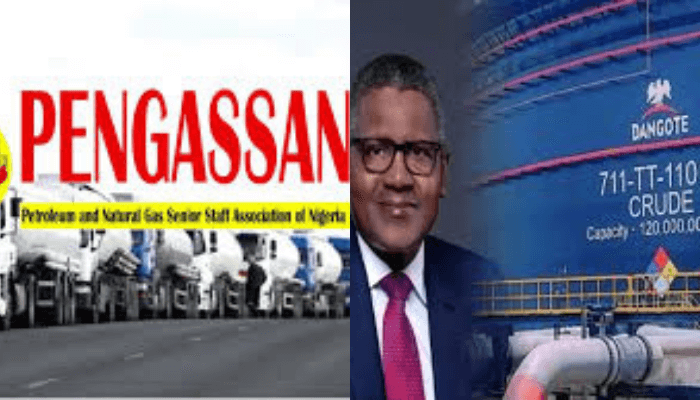
The Petroleum and Natural Gas Senior Staff Association of Nigeria (PENGASSAN) has escalated its dispute with Dangote Refinery by directing members to embark on industrial action and cut gas supplies to the $20 billion facility. In a statement released on Saturday by its General Secretary, Lumumba Okugbawa, the union ordered members in various field locations to withdraw services beginning 6 a.m. on Sunday, September 28.
The directive covers all control room operations, panel activities, and field personnel, with specific instructions to halt crude oil and gas supply to the refinery. Effectively, this action jeopardizes operations at Nigeria’s largest refinery, an investment hailed as a game-changer for the country’s energy sector. Many Nigerians have reacted with alarm, describing the move as economic sabotage capable of returning the country to the dark days of fuel scarcity and heavy reliance on imports.
At the heart of the standoff lies a clash between labour rights and corporate freedom. PENGASSAN is demanding the reinstatement of 800 workers allegedly dismissed for union activities. Dangote Refinery, however, maintains its stance against trade unionism within its operations, insisting that while Nigerian labour laws allow workers to unionise, employers equally have the right to restrict union activities within private enterprises.
This position mirrors practices across several sectors. For instance, private universities in Nigeria operate without the Academic Staff Union of Universities (ASUU), while private banks and insurance companies phased out the once-powerful NUBIFE union during privatisation in the late 1980s and 1990s. In these sectors, attractive reward systems replaced union influence, reducing labour disruptions. Similar restrictions exist in aviation, tourism, and power.
Critics argue that unions such as PENGASSAN and NUPENG have long resisted Dangote’s efforts. As far back as 2007, when former President Olusegun Obasanjo offered to sell the ailing Port Harcourt refinery to Aliko Dangote, labour unions strongly opposed the move. Dangote instead built his own refinery, now the world’s largest single-train facility. Meanwhile, Nigeria’s government-owned refineries remain inactive despite billions spent on turnaround maintenance, yet their workers—still union members—continue to draw salaries and pay dues to union leaders.
The current threat to disrupt Dangote Refinery raises concerns about Nigeria’s investment climate. “No serious investor will put money in a country where unions can cripple multi-billion-dollar private investments at will,” some observers warn.
Despite disengaging 800 staff, Dangote Refinery still employs over 3,000 Nigerians directly, alongside thousands more in indirect jobs, suppliers, and contractors. Supporters insist the federal government must act decisively to safeguard the refinery from union-led disruptions, stressing that protecting strategic private investments is essential for Nigeria’s economic stability.