





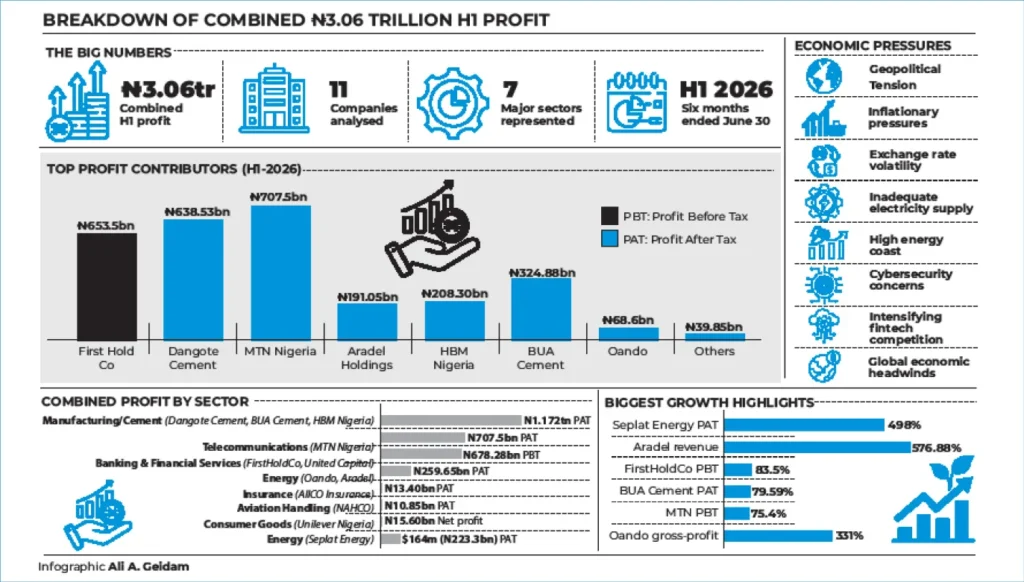
Eleven companies listed on the Nigerian Exchange Limited generated a combined N3.06tn in profit during the first half of 2026, with banking, cement, telecommunications and energy firms leading a broad-based earnings surge despite Nigeria’s difficult operating environment.
Nigeria’s corporate sector has delivered a surprisingly strong earnings performance in the first half of 2026, with 11 companies listed on the Nigerian Exchange Limited reporting a combined profit of about N3.06tn.
An analysis of the companies’ unaudited H1 financial statements showed that firms across banking, manufacturing, telecommunications, energy, aviation handling, insurance and consumer goods strengthened their earnings despite persistent inflation, exchange-rate volatility, high energy costs and other macroeconomic challenges.
The companies also had to contend with geopolitical tensions, inadequate electricity supply, rising cybersecurity risks, competition from fintech operators and uncertainty in the global economy.
Banks, cement makers dominate profit league
The banking and manufacturing sectors accounted for a significant portion of the reported earnings, with several companies recording double-digit or even triple-digit growth in profit.
FirstHoldCo Plc led the banking performance after posting a profit before tax of N653.5bn for the six months ended June 30, 2026, representing an 83.5 per cent increase from the previous year.
Gross earnings rose 16.7 per cent to N1.93tn, while operating income increased by 25.8 per cent to N1.38tn.
Profit after tax also climbed by 81.6 per cent to N526.1bn from N289.8bn.
Group Chairman of FirstHoldCo, Femi Otedola, described the performance as an important milestone in the group’s transformation and long-term growth strategy.
United Capital Plc also reported a sharp improvement in earnings, with profit before tax rising 79.62 per cent to N24.78bn.
Profit after tax increased 77.45 per cent to N21.10bn, while earnings per share rose to 234 kobo from 132 kobo.
The cement industry also produced blockbuster numbers.
Dangote Cement Plc, BUA Cement Plc and HBM Nigeria Plc collectively posted N1.17tn in profit after tax, representing an additional N337.65bn compared with the corresponding period of 2025.
Dangote Cement remained the biggest profit generator among the three, reporting N638.53bn in profit after tax, up 22.69 per cent from N520.46bn.
Revenue increased 21.35 per cent to N2.51tn, while profit before tax jumped 34.43 per cent to N981.39bn.
BUA Cement recorded the fastest profit growth in the group, with profit after tax surging 79.59 per cent to N324.88bn.
Revenue rose 25.61 per cent to N728.93bn, while profit before tax increased to N384.44bn.
HBM Nigeria also recorded significant growth, with profit after tax rising 57.03 per cent to N208.30bn and revenue increasing 31.23 per cent to N678.4bn.
MTN posts record half-year profit
The telecommunications sector produced another standout performance, with MTN Nigeria Communications Plc reporting its highest-ever half-year profit before tax of N1.09tn.
The figure represented a 75.4 per cent increase year-on-year.
Revenue climbed 25.9 per cent to N2.99tn, driven largely by sustained demand for data and improvements in operating efficiency.
Profit after tax increased 70.6 per cent to N707.5bn.
The company’s stronger earnings enabled its board to approve an interim dividend of N26 per share, payable on September 7, 2026, to shareholders whose names appear on the register as of August 20.
Shareholders’ equity increased 69.6 per cent to N930.6bn, while earnings per share also rose 70.6 per cent to N33.76.
MTN Nigeria CEO, Karl Toriola, attributed the performance to sustained commercial momentum, improved profitability and stronger cash generation despite the challenging macroeconomic environment.
Oil and gas firms deliver explosive growth
Energy companies were also among the major contributors to the earnings boom.
Seplat Energy Plc recorded a 498 per cent increase in profit after tax to $164m.
Revenue rose to $1.82bn from $1.398bn, while cash generated during the period reached $985.9m.
Production averaged 139,509 barrels of oil equivalent per day, up from 134,492 boepd in H1 2025.
The company also entered into an agreement with NNPC Limited to sell a 10 per cent interest in the NNPCL-SEPNU Joint Venture.
Seplat said the transaction was expected to enhance shareholder returns, with total expected dividends for 2026 projected at 68.3 US cents per share.
Oando Plc also recorded stronger earnings, with revenue rising 20 per cent to N2.1tn and profit after tax increasing eight per cent to N68.6bn.
Gross profit jumped 331 per cent to N101bn, while average daily production increased 16 per cent to 42,789 boepd.
Aradel Holdings Plc recorded one of the most dramatic revenue increases among the companies reviewed, with revenue soaring 576.88 per cent to N2.49tn from N368.08bn.
The company reported profit before tax of N752.71bn and profit after tax of N191.05bn.
Smaller players also hold their ground
The earnings improvement was not limited to Nigeria’s biggest corporations.
Nigerian Aviation Handling Company Plc reported a 22 per cent increase in profit during the first half.
Revenue rose to N35.36bn, while operating profit increased 25.4 per cent to N14.59bn.
Profit before tax grew 21.8 per cent to N14.37bn, while profit after tax increased 22.2 per cent to N10.85bn.
In the insurance sector, AIICO Insurance Plc recorded a 14.53 per cent increase in insurance revenue to N74.93bn.
Profit before tax climbed 20.63 per cent to N15.05bn, while profit after tax rose 18.94 per cent to N13.40bn.
The company attributed the improvement to stronger underwriting margins and investment income.
Unilever Nigeria Plc also reported stronger first-half earnings.
Turnover increased 22 per cent to N119.9bn from N98.1bn, while gross profit grew 30 per cent to N54.7bn.
Net profit rose to N15.6bn from N14.4bn.
What the numbers mean for investors
The earnings reports point to a broad improvement in corporate profitability despite the pressures confronting Nigerian businesses.
For investors, the results could reinforce confidence in some of the market’s major listed companies, particularly those benefiting from stronger pricing, increased demand, improved production and better cost management.
However, analysts will be watching closely to determine whether the earnings momentum can be sustained amid inflationary pressures, currency movements, high operating costs and global economic uncertainties.
With the first half of 2026 now producing multitrillion-naira profits among a relatively small group of listed companies, attention will increasingly shift to whether the broader NGX market can translate the earnings recovery into stronger valuations, dividends and investor returns in the second half of the year.