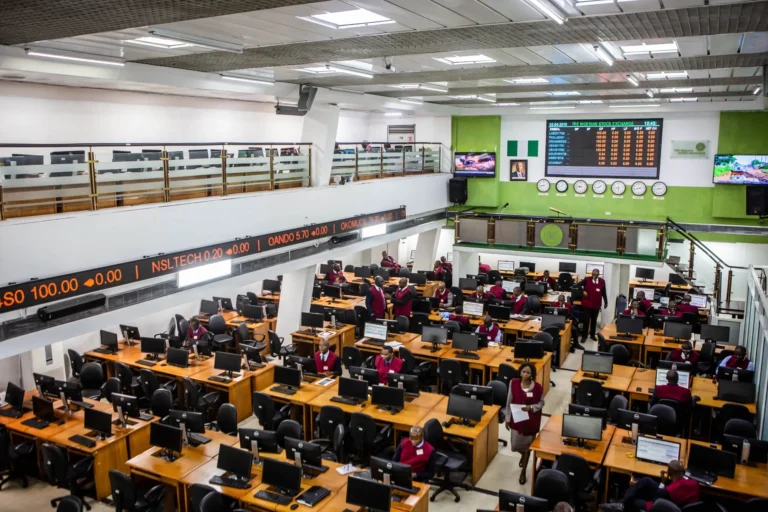






Nigeria’s equities market closed lower on Tuesday as investors moved to lock in gains from recent rallies, triggering broad-based sell-offs in several large-cap stocks.
The decline pushed the Nigerian Exchange market capitalisation down by about N468.63bn, from N163.99tn at the previous session to N163.53tn at the close of trading.
The benchmark All-Share Index also weakened by 721.91 points, representing a 0.29 per cent decline, to settle at 251,913.20 points from Monday’s 252,635.11 points.
Trading activity showed increased selling pressure across some of the market’s major sectors, particularly banking, industrial and consumer goods stocks.
Sovereign Trust Insurance recorded the steepest decline among the listed equities, falling 9.92 per cent to close at N2.36 per share.
Unilever Nigeria followed with an 8.55 per cent loss, ending the session at N100.50.
Neimeth International Pharmaceuticals also came under significant selling pressure, declining 6.02 per cent to N7.80, while BUA Cement lost 3.10 per cent to close at N287.80.
The banking segment was not spared as major financial stocks also recorded losses.
Guaranty Trust Holding Company fell 3.28 per cent to N132.50, while Zenith Bank declined by 1.03 per cent to finish at N134.00.
The downward movement in several heavyweight counters was enough to outweigh gains recorded in other parts of the market, resulting in the overall decline in the benchmark index.
However, some equities bucked the negative trend and posted double-digit gains.
NPF Microfinance Bank and LivingTrust Mortgage Bank topped the gainers’ table after each appreciated by 10 per cent.
NPF Microfinance Bank closed at N4.40 per share, while LivingTrust Mortgage Bank finished at N2.86.
The contrasting performance across sectors reflected a session in which investors appeared more focused on taking profits from stocks that had recorded previous gains, even as buying interest remained evident in selected counters.
The market’s decline therefore represented a reversal of the positive performance recorded in the preceding session, with the All-Share Index giving up part of its recent advance.
Market capitalisation, which broadly represents the value of listed equities, also declined in line with the movement in share prices.
The latest session highlights the continued influence of investor positioning and profit-taking on short-term movements in the Nigerian equities market, particularly when selling pressure is concentrated in heavily capitalised stocks.
With major banking, industrial and consumer names accounting for substantial portions of the market’s overall valuation, movements in these counters can have a significant effect on the direction of the benchmark index.
For investors, attention remains on how the market responds in subsequent sessions as buying interest in selected stocks competes with efforts by existing shareholders to realise gains.