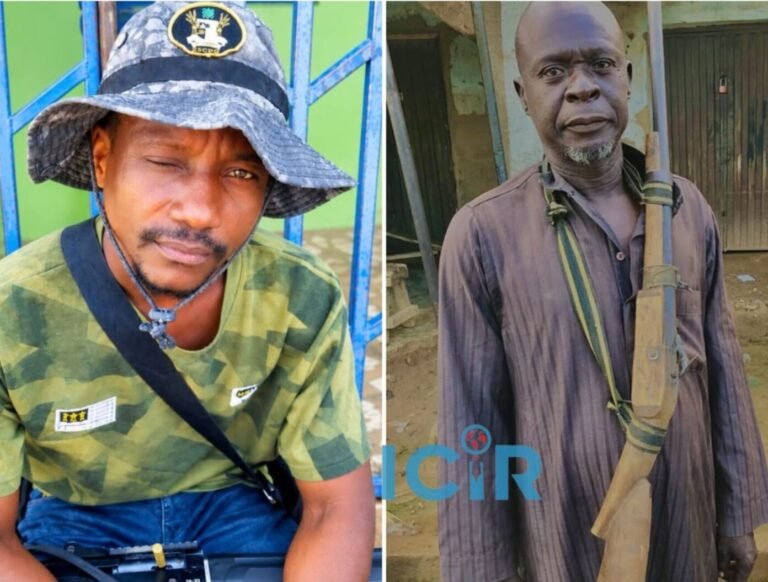





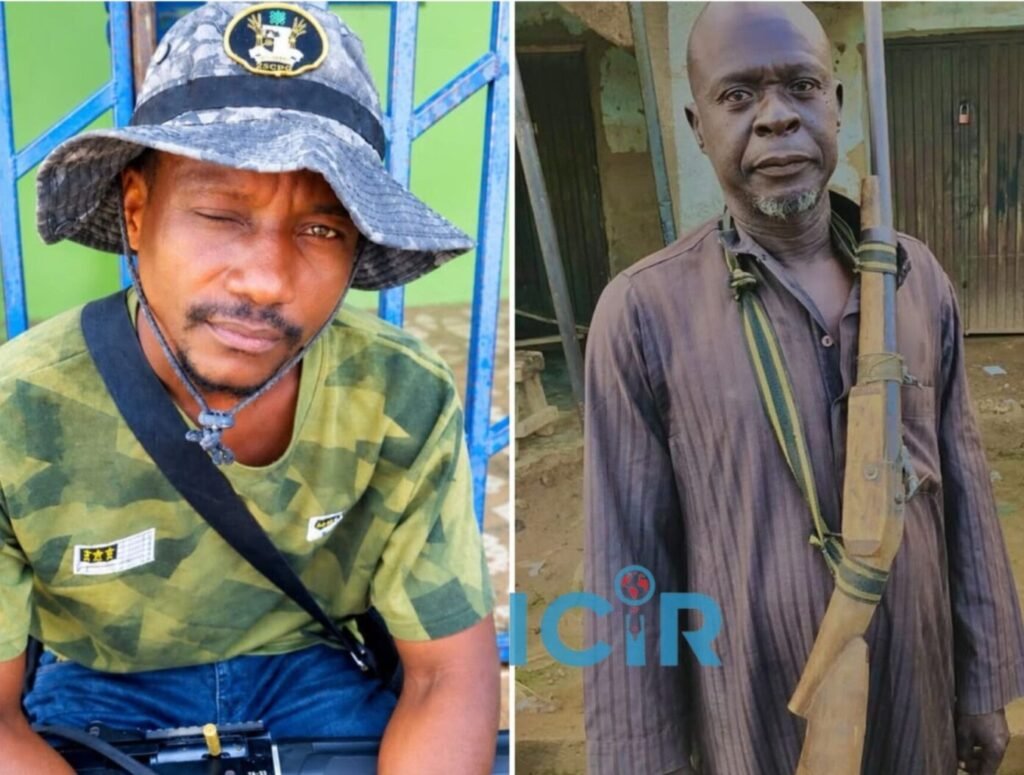
Civilian vigilantes helping to protect communities from armed groups across Northern Nigeria are paying a heavy price, with some losing their lives or suffering life-changing injuries while receiving little or no financial or medical support.
An investigation by The ICIR across Zamfara, Niger and Kogi states has exposed serious welfare challenges confronting these community security volunteers, including inadequate medical care, lack of insurance and the absence of reliable compensation for families of those killed in service.
For many of these fighters, the struggle does not end when they survive an encounter with armed attackers. They must also find money for treatment, cope with permanent disabilities and support their families without any guarantee of assistance from the authorities.
Vigilante loses hand defending his community
Abdullahi Ibrahim, a vigilante in Gima community, Anka Local Government Area of Zamfara State, still carries a firearm despite losing his left hand in a gun battle with bandits in 2024.
His injury followed years of insecurity in the area. Ibrahim recalled that armed men attacked his community in 2020 and abducted two women. One of the victims, who was pregnant, was later released, while the other regained her freedom after a ransom of ₦1 million was paid.
As attacks continued, residents began organising local volunteers to defend their communities.
Ibrahim understood the dangers involved but did not expect that one encounter would leave him permanently disabled.
The injury has affected his ability to carry out everyday activities and placed a significant financial burden on him. He said he spent more than ₦250,000 on medical treatment and related care but received no assistance from the government or its agencies.
His experience reflects the difficult conditions facing many civilian volunteers who have become part of local security arrangements in areas frequently attacked by armed groups.
Volunteers fund their own security operations
Across Nigeria, community vigilantes have increasingly supported formal security agencies, particularly in locations where residents face repeated attacks, kidnappings and threats from armed groups.
In Zamfara, Niger and Kogi states, government-backed arrangements include the Community Protection Guards (CPGs), Niger State Vigilante Corps (NSVC) and Kogi State Vigilante Service.
However, other groups operate independently and are commonly known as Yan sa-kai.
These volunteers have supported security agencies in rescuing kidnapped people, protecting farmers and farmlands, arresting suspects and participating in joint operations with the police and military.
Despite their contributions, interviews conducted by The ICIR with vigilante leaders and families of deceased members point to significant gaps in the protection available to those injured or killed while carrying out security duties.
Some groups have no life insurance policies or formal compensation arrangements. In several cases, families of deceased volunteers reportedly receive little or no financial support after losing their breadwinners.
Members sell personal belongings to buy weapons
In parts of Zamfara State, particularly Anka and Bukkuyum local government areas, community vigilante groups became active again as attacks on residents increased several years ago.
Yusuf Sani, a commandant of a volunteer vigilante group in Anka, said residents had repeatedly appealed to authorities for help but continued to face attacks.
He explained that members sacrifice their time and personal resources to protect their communities, including staying awake at night when security threats arise.
The group draws its membership from different occupations, including farming, livestock rearing, manual labour and trading.
Rather than depend on government funding, members contribute from their earnings to sustain their operations. Some even sell harvested crops, livestock and other personal belongings to purchase equipment and ammunition.
“Whatever we earn from our labour, we use it to support our activities. Even when it comes to obtaining our guns or ammunition,” Sani said.
He estimated that more than 200 members operate under his command, although the wider network across Anka may be larger.
According to him, between 28 and 30 members have been killed since 2020, while approximately 20 others have sustained injuries.
The figures highlight the human cost of community-led security efforts in an area affected by persistent armed attacks.
No formal support for injured members or bereaved families
Another vigilante leader, Sani Garba, described similar challenges confronting volunteers in the area.
He said his group had existed for more than two decades and originated from the traditional Yan Banga community protection system, through which local residents helped maintain order and protect their neighbourhoods.
Although the group was revived about six years ago, Garba said it was not formally registered or officially recognised, despite local government officials and traditional authorities being aware of its activities.
He said members largely handled their own expenses, including medical bills for injured colleagues and burial arrangements for those killed.
According to him, no government agency had provided dependable financial assistance for these responsibilities.
The situation leaves volunteers and their families exposed to serious financial hardship, even when injuries or deaths occur during efforts to protect their communities.
Why existing compensation laws may not cover all vigilantes
Nigeria’s Employees’ Compensation Act 2010 provides for compensation to eligible employees who suffer work-related injuries, disabilities or diseases. It also provides benefits for dependants of workers who die as a result of employment-related injuries.
However, the law does not automatically establish coverage for independently organised community vigilantes who operate outside formal employment arrangements.
This creates a protection gap for volunteers who are neither formally employed nor paid by government.
The investigation also notes that Nigeria has not ratified the International Labour Organisation’s Employment Injury Benefits Convention, 1964 (No. 121), which sets out international standards relating to medical care, rehabilitation and compensation for employment-related injuries and deaths.
Consequently, members of independent vigilante groups and organisations whose members are not necessarily government employees may have no automatic entitlement to benefits under the existing employment-based compensation framework.
Different levels of support for government-backed and community groups
The conditions under which vigilantes operate vary across the three states covered by the investigation.
Some members recruited into government-backed security arrangements receive official support, including vehicles, firearms and bulletproof vests.
Others, particularly independently organised groups, operate with limited equipment and depend heavily on contributions from community members.
Some of these groups are also not formally registered, making their relationship with government authorities less structured.
The difference raises important questions about how Nigeria can benefit from community participation in security operations while ensuring that people who risk their lives are not abandoned when they suffer injuries or lose their lives.
For volunteers such as Ibrahim, surviving a gun battle is only part of the struggle. The cost of treatment, permanent disability and the absence of institutional support can leave them facing another battle long after the shooting stops.
As insecurity continues to threaten communities, the experiences documented in Zamfara, Niger and Kogi underline the need for clearer welfare arrangements, access to medical care, insurance and compensation for vigilantes and their families.