




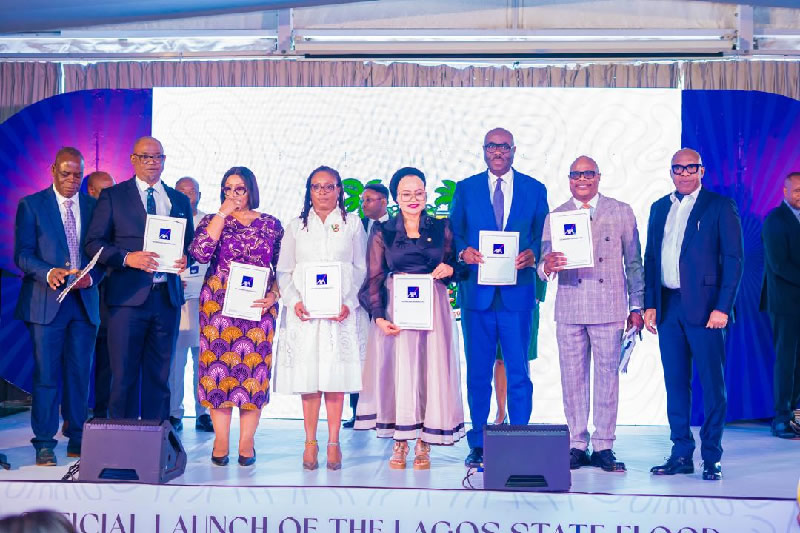
Here is a more professional and concise rewrite of the photo caption: **L–R:** Lead Consultant on the Flood Policy, Dr Olugbenga Oluwole; Permanent Secretary, Ministry of Finance, Mr Tajudeen Mahmud; Permanent Secretary, Office of Sustainable Development Goals, Mrs Olayemi Sarumi; Special Adviser, Office of Sustainable Development Goals, Dr Oreoluwa Finnih; Secretary to the State Government, Mrs Abimbola Salu-Hundeyin; Lagos State Commissioner for Finance, Mr Abayomi Oluyomi; Permanent Secretary, Lagos State Emergency Management Agency, Dr Olufemi Osanyintolu; and Accountant-General/Permanent Secretary, State Treasury Office, Dr Muyiwa Adetola, at the signing of the Lagos State Flood Risk Insurance Policy in Lagos on Wednesday. Photo: Lagos State Ministry of Finance.
The Lagos State Government has introduced a flood-risk insurance scheme aimed at protecting more than four million vulnerable residents across high-risk communities, with potential payouts of up to $7.5 million per flood event.
Governor Babajide Sanwo-Olu, represented by the Secretary to the State Government, Abimbola Salu-Hundeyin, announced the initiative at its official launch in Victoria Island. The programme marks a strategic shift from reactive disaster response to proactive risk management, reinforcing the state’s commitment to safeguarding lives, livelihoods, and critical infrastructure.
According to a statement from the Ministry of Finance, the scheme will cover residents in flood-prone local government areas, including Ajeromi-Ifelodun, Alimosho, Amuwo-Odofin, Apapa, Kosofe, and Ojo. It is fully funded by the Lagos State Government, meaning beneficiaries will not be required to pay premiums or complete complex registration processes. Identification and support will instead rely on existing social databases, such as records from the Lagos State Residents Registration Agency.
Sanwo-Olu described the initiative as a “decisive change” in addressing climate-related risks, noting that it ensures timely, transparent, and dignified support for affected communities when disasters occur. He also called on the Federal Government and other states to adopt similar models, describing it as a scalable approach to protecting vulnerable populations nationwide.
Commissioner for Finance, Abayomi Oluyomi, emphasised the scheme’s role as a fiscal protection mechanism that will enhance emergency response and recovery efforts. He warned that Lagos, as a coastal megacity, remains highly exposed to climate threats such as rising sea levels and extreme rainfall, with projections suggesting potential economic losses of up to $40 billion by 2050 if no action is taken.
“This initiative is not just insurance—it is a resilience tool that reflects Lagos State’s commitment to long-term, forward-looking planning,” Oluyomi said.
The scheme is supported by international partnerships, with the German Government, through the InsuResilience Solutions Fund, covering 90 per cent of the insurance premium in its first year, while Lagos State funds the remaining 10 per cent. The collaboration, which emerged from engagements at COP27 in Egypt, highlights the importance of global cooperation in addressing climate challenges.
Special Adviser to the Governor on Sustainable Development Goals, Dr Oreoluwa Finnih, described the programme as a milestone in strengthening fiscal sustainability and inclusive governance. She noted that the initiative integrates satellite technology to ensure transparency and is designed to address multiple types of flooding, including rainfall-induced, river-based, and coastal flooding.
Finnih added that the scheme would be embedded within the operations of the Lagos State Emergency Management Agency to ensure effective coordination and targeted intervention.
The flood insurance programme was developed in partnership with several international and private sector organisations, including the United Nations Development Programme, the European Union, the World Bank, the African Development Bank, and leading insurance and risk management firms.
Officials say the initiative represents a major step toward building climate resilience in Lagos, ensuring that financial protection is in place before disasters strike.