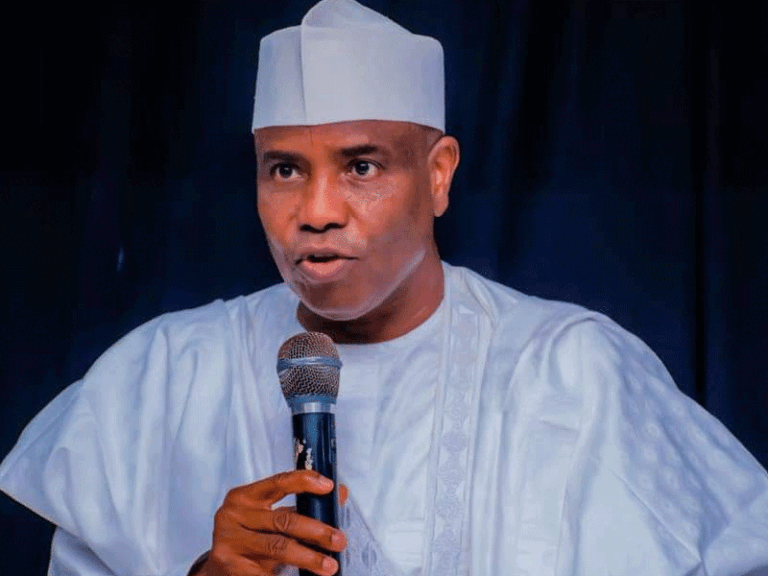






Oluwole Olusoji, immediate past President of the Association of Senior Staff of Banks, Insurance and Financial Institutions (ASSBIFI) and current Deputy President of the Trade Union Congress (TUC), has called on Nigerian leaders to align their actions with the everyday realities of citizens.
Reflecting on his three-year tenure at ASSBIFI, Olusoji described his transition from office as a period of relative relief, offering him more time for personal commitments and broader societal engagement. Despite this, he remains deeply concerned about the state of Nigerian workers and the wider economy.
He noted that while government policies often appear well-intentioned, there is a persistent gap between formulation and implementation. According to him, rising living costs—covering healthcare, education, housing, energy, and security—have significantly eroded workers’ earnings, leaving many struggling to maintain a decent standard of living.
Olusoji stressed that the issue extends beyond wages, pointing instead to the failure of public services that should enhance the value of income. He also criticized what he described as a lack of accountability among public officials, arguing that many do not exemplify the standards they expect from citizens. He cited the continued reliance on foreign healthcare and education by leaders as evidence of this disconnect.
“It is one thing to mean well, and another to act well,” he said, emphasizing the need for leadership by example.
Despite these concerns, Olusoji acknowledged some areas of progress. He pointed to ongoing banking sector reforms, particularly recapitalisation, which he said have been better structured than in the past and have not resulted in significant job losses so far. He added that stronger capital bases could potentially drive expansion and create employment opportunities.
On the impact of emerging technologies such as artificial intelligence, Olusoji described both risks and opportunities. While acknowledging that certain roles may become obsolete, he emphasized that workers who adapt and acquire relevant skills can benefit from increased productivity and new career paths.
He urged both government and private sector organisations to invest in workforce training to ensure employees are prepared for technological shifts. Drawing parallels with previous industrial transitions, he noted that while change can disrupt existing roles, it often creates new opportunities for those willing to evolve.
Olusoji concluded that Nigeria’s progress depends largely on leadership that genuinely understands and shares in the experiences of ordinary citizens. Without this, he warned, the gap between policy intentions and real-life outcomes will continue to widen.